
REITs in India 2026: How to Earn Rental Income Without Buying Property

Rohit is a 34-year-old software engineer in Pune. He earns ₹18 lakh a year, saves decently, and has been reading about commercial real estate for two years. The kind where companies like Google and Deloitte sign 5-year leases and pay rent like clockwork. He’d love a piece of that income. But a commercial office in Bengaluru or Hyderabad costs ₹5–10 crore minimum.
Then he discovered REITs — Real Estate Investment Trusts (REITs) — and bought his first unit for ₹460.
That’s not a typo. One unit of Mindspace Business Parks REIT was trading at ₹460.05 on the NSE as of 27 May 2026 (source: Angel One). Rohit now earns quarterly rental income from premium IT parks without owning a single square foot of property, dealing with a single tenant, or filing a single maintenance request.
And if he can do it on a salaried income, so can you.
What This Article Covers
What Is a REIT and How Does It Actually Work?
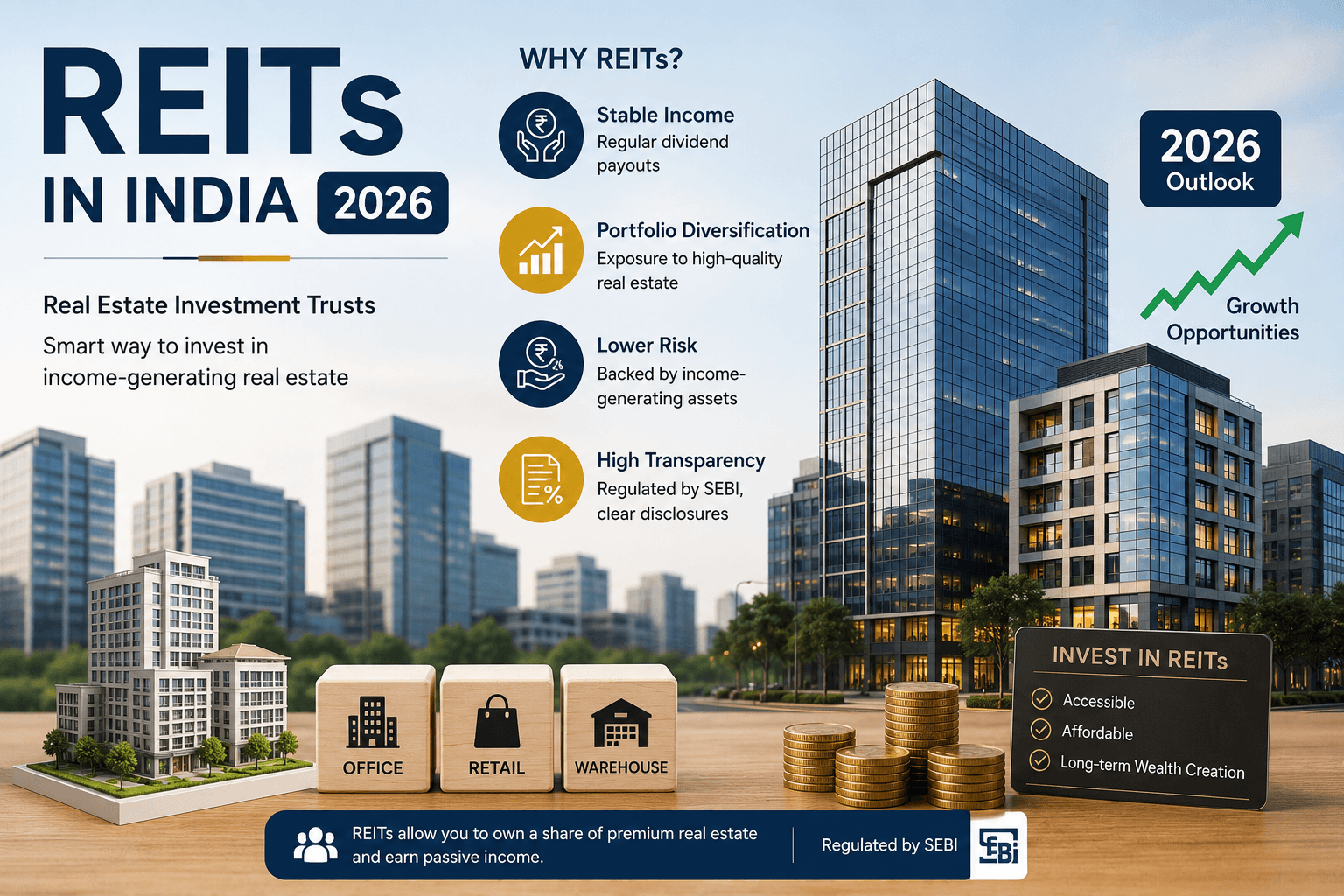
A Real Estate Investment Trust (REIT) is a SEBI-regulated trust that owns and manages income-generating commercial properties — office parks, shopping malls, warehouses. It pools money from thousands of investors, buys those properties, collects rent from corporate tenants, and distributes at least 90% of that rental income back to investors every quarter.
SEBI mandates this 90% distribution. It isn’t optional or at management’s discretion. Additionally, at least 80% of REIT assets must be in completed, rent-generating properties — not under construction, not speculative bets.
Here’s the structure in plain English. A REIT typically holds assets through Special Purpose Vehicles (SPVs) — separate legal entities created to hold individual properties or clusters of properties. The REIT collects rental income from these SPVs, pools it, and distributes it to unitholders like you. This SPV structure matters for tax — because the tax treatment of each component of your distribution depends partly on which tax regime the SPV is on. (More on that in the tax section below.)
Think of a REIT like a mutual fund — except instead of owning shares of companies, the fund owns actual buildings. And instead of dividends from companies, you get rent from their offices.
In India, REITs are listed on the National Stock Exchange (NSE) and Bombay Stock Exchange (BSE) and trade exactly like stocks. You buy and sell units through your existing demat (dematerialised) account. Since SEBI reduced the minimum lot size to 1 unit in 2023, you can start with as little as ₹300–500 for most REITs.
The 5 REITs Listed in India in 2026
As of 2026, India has five publicly listed REITs — a major milestone from the single listing in 2019. Together they manage assets worth ₹2.4 lakh crore, have over 2.5 lakh unitholders, and have collectively distributed more than ₹26,500 crore to investors since launch. That number already exceeds the combined dividends paid by all companies in the entire Nifty Realty Index (source: Embassy REIT Investor Resources, as of September 2025).
| REIT (Ticker) | What It Owns | Key Cities | Occupancy (FY26) | Approx. Yield |
| Embassy Office Parks REIT (EMBASSY) | Premium office parks | Bengaluru, Mumbai, Pune, NCR, Chennai | 92–93% | ~5.3% |
| Mindspace Business Parks REIT (MINDSPACE) | IT parks, SEZs | Hyderabad, Mumbai, Pune, Chennai | 97% (excl. Hyd property) | ~5–6% |
| Brookfield India Real Estate Trust (BIRET) | Office parks | Mumbai, NCR, Kolkata | 96% | ~5.1% |
| Nexus Select Trust (NEXUS) | Premium shopping malls | 17 cities across India | 97.2% | ~5–6% |
| Knowledge Realty Trust (KRT) | Grade A offices | Hyderabad, Mumbai, Bengaluru, Chennai, Gurugram, Ahmedabad | 91.4% | ~5% |
Source: Wright Research (March 2026), Smallcase (May 2026), Embassy REIT Investor Resources, Angel One (May 2026)
Embassy Office Parks REIT (EMBASSY)
India’s first listed REIT — launched in April 2019 and jointly backed by Embassy Group and Blackstone. It owns some of India’s best-known office campuses, including Embassy Manyata Business Park and Embassy TechVillage in Bengaluru, managing over 45 million square feet across five cities. In Q3 FY26, it declared distributions of ₹6.47 per unit, translating to a dividend yield of approximately 5.3% (source: Wright Research, March 2026). If stability and the deepest liquidity are your priorities, Embassy is the benchmark.
Mindspace Business Parks REIT (MINDSPACE)
Mindspace owns around 34 million square feet of IT parks and Special Economic Zones (SEZs) across Hyderabad, Mumbai, Pune, and Chennai. Its tenant roster is blue-chip — Accenture, Barclays, Deloitte — companies that rarely default on rent. Since listing in 2020, Mindspace has delivered a Compounded Annual Growth Rate (CAGR) of 8.85% with the lowest volatility among all listed Indian REITs (source: Wright Research, March 2026). Morgan Stanley upgraded it to overweight in early 2026, projecting 20.5% FY27 returns.
Brookfield India Real Estate Trust (BIRET)
Brookfield is the only 100% institutionally managed REIT in India — every asset is managed by Brookfield Asset Management, one of the world’s largest real estate managers. It holds 14 million square feet across Mumbai, NCR, and Kolkata with 96% committed occupancy in FY26 (source: Groww, May 2026). If institutional-grade management gives you confidence, BIRET is worth a look.
Nexus Select Trust (NEXUS)
Nexus is India’s only listed retail REIT — it owns 17 premium shopping malls across 17 cities. If you want exposure to India’s consumption story rather than office leasing, this is your only listed REIT option. Reported occupancy of 97.2% in FY26 signals strong retail recovery post-pandemic.
Knowledge Realty Trust (KRT)
The newest and largest of the five by Gross Asset Value (GAV), KRT listed on NSE and BSE in August 2025 via a ₹4,800 crore IPO. Backed by Blackstone and Sattva Group, it holds 30 Grade A office assets totalling 46.3 million square feet across Hyderabad, Mumbai, Bengaluru, Chennai, Gurugram, and Ahmedabad — making it the second-largest office REIT globally by leasable area (source: Knowledge Realty Trust IPO documents, August 2025). With tenants including Amazon and Google, and committed occupancy of 91.4%, KRT brings significant heft to India’s REIT universe.
How Much Can You Actually Earn?
REIT returns come from two sources: quarterly distributions (rental income passed through to you) and capital appreciation (the unit price rising over time).
Most Indian REITs have been paying distribution yields in the range of 5–7% annually, credited to your bank account every quarter automatically. For context, a 5-year fixed deposit (FD) at a major bank currently pays 6.5–7%, but that’s taxed fully at your slab rate. REIT distributions have a more complex — and sometimes more efficient — tax structure, which we’ll break down below.
On total return, Mindspace delivered a CAGR of 8.85% since its listing in August 2020, combining distribution income and unit price appreciation (source: Wright Research, March 2026). That’s not a guaranteed future number — it’s historical data — but it gives you a sense of what the asset class has been able to do.
Back to Rohit’s story. Say he puts ₹5 lakh into Embassy REIT at a 6.8% annual distribution yield. That’s ₹34,000 per year, or about ₹8,500 landing in his account every quarter — without a single call to a tenant, without a single water bill, without any of the headaches that come with owning actual property.
That said, distributions are not fixed like FD interest. They move with occupancy, lease renewals, and new acquisitions. In good years they can grow; in tough years they may dip.
How to Buy a REIT Unit — Step by Step
You don’t need to do anything special. If you already invest in stocks or mutual funds, you have everything you need.
- Open or use your existing demat account. A demat (dematerialised) account is the electronic account that holds your securities — shares, mutual fund units, REIT units. Any SEBI-registered broker — Zerodha, Groww, Angel One, HDFC Securities — supports REIT trading on NSE and BSE. If you already invest in stocks, your existing account works perfectly. If you don’t have one yet, you can open one online in 15–20 minutes with Aadhaar and PAN (source: Embassy REIT, How to Invest in REIT).
- Search by NSE/BSE ticker. On your trading app, search: EMBASSY, MINDSPACE, BIRET, NEXUS, or KRT.
- Check the current unit price and trailing yield. Distribution yield = (sum of last 4 quarterly distributions per unit ÷ current market price) × 100. Check the REIT’s latest quarterly investor presentation — freely available on SEBI’s website or the REIT’s investor relations page — for occupancy and distribution history.
- Place a buy order. Select quantity (minimum 1 unit since SEBI’s 2023 rule change), choose market or limit price, and execute. Unit prices as of late May 2026: Mindspace at ₹460.05 (NSE); Embassy REIT market cap at ₹40,021 crore (source: Angel One, INDmoney, May 2026).
- Receive quarterly distributions. Credited directly to the bank account linked to your demat. No paperwork, no tenant calls, no maintenance costs.
Total time to complete steps 1–5 if you already have a demat account: under 5 minutes.
Tax on REIT Income — What You’ll Actually Pay
Important for salaried investors in the 30% tax bracket: the interest component of your REIT distributions will be taxed at your full slab rate. For high earners, this makes REIT income less tax-efficient than equity fund returns. Factor this into your decision before investing.
REIT distributions are not a single tax bucket. Each quarterly payment can contain a mix of components, and each component is taxed differently. The table below breaks it down clearly.
| Distribution Type | Taxable? | Tax Rate (Resident) | TDS Applicable? |
| Interest income | Yes | At your slab rate (20% or 30%) | Yes – 10% if >₹10,000 p.a. |
| Dividend (SPV opted for Sec 115BAA) | Yes | At your slab rate | Yes – 10% if >₹10,000 p.a. |
| Dividend (SPV NOT on 115BAA regime) | Exempt in your hands | Nil | No TDS deducted |
| Return of capital / SPV debt repayment | Not taxed now | Reduces acquisition cost (impacts future capital gains) | No |
| STCG on unit sale (held <12 months) | Yes | 20% | Broker deducts STT |
| LTCG on unit sale (held >12 months) | Yes, above ₹1.25 lakh | 12.5% | Broker deducts STT |
Source: 1Finance (2025), PrimeInvestor (December 2025), Finnovate (March 2026), Income Tax Act FY 2025-26
At the end of each financial year, REITs issue Form 64B to all unitholders — a detailed breakdown of exactly what each quarterly distribution contained: interest, dividend, rental income, or return of capital. You use this form when filing your Income Tax Return (ITR) to compute your actual tax liability (source: PrimeInvestor, December 2025).
Short-Term Capital Gains (STCG) applies when you sell units held for under 12 months — taxed at 20%. Long-Term Capital Gains (LTCG) applies for units held over 12 months — taxed at 12.5% on gains above ₹1.25 lakh (post-Budget 2024). This is the same rate as equity mutual fund LTCG, which is one reason REITs are increasingly attractive versus other asset classes.
REITs vs Buying Property vs Mutual Funds
| Parameter | Physical Property | REIT | Equity Mutual Fund |
| Minimum investment | ₹50 lakh+ | ₹300–500 (1 unit) | ₹500 (SIP) |
| Liquidity | Months to sell | Same day (exchange listed) | 1–3 business days |
| Regular income | Yes — but irregular, tenant-dependent | Yes — quarterly, auto-credited | No direct income |
| Tenant / management hassle | High — yours to handle | Zero — fully managed | Zero |
| Tax on income | Rental income at slab rate | Component-based (see tax table) | LTCG 12.5% / STCG 20% |
| Diversification | Single property, single city | Multiple premium properties, multiple cities | Across many companies |
| SEBI regulated | No | Yes | Yes |
Source: Motilal Oswal (March 2026), Embassy REIT, SEBI REIT Regulations 2014
The comparison most people miss: a premium commercial office in Bengaluru or Hyderabad — the exact kind that Embassy or Mindspace owns — would cost ₹5–10 crore to buy outright. You’d need to find tenants yourself, manage lease renewals, pay maintenance, and potentially wait months to sell if you need liquidity. REITs give you the same underlying asset — the same buildings, often the same tenants — for a few hundred rupees per unit, with automatic quarterly income and same-day exchange liquidity.
Risks You Should Know Before Investing
REITs are not fixed deposits. Unit prices can fall, distributions can reduce, and there are real risks to understand before putting money in.
1. Interest rate risk.
When bond yields rise, REIT distributions look less attractive in comparison, and unit prices typically fall. India’s 10-year government bond yield rose to 7.0% by end of March 2026 — a 20-month high — creating some valuation pressure on REITs (source: Smallcase, May 2026).
2. Occupancy and tenant risk.
If major tenants vacate or don’t renew leases, rental income falls and distributions drop. This is why occupancy data matters — a REIT with 95%+ occupancy is far less vulnerable than one sitting at 80%.
3. Work-from-home risk — but nuanced.
The WFH narrative was genuinely threatening in 2020–21. In 2026, the data tells a different story. India’s office market achieved its best-ever leasing year in 2025 at 83.3 million square feet of gross leasing (source: JLL, via The Flex Insights, January 2026). Global Capability Centres (GCCs) — the India-based operations hubs of multinational companies like JPMorgan, Apple, and BMW — accounted for 50–60% of gross leasing in FY26 across listed REITs (source: Groww, May 2026) and hit a record 9.1 million square feet of leasing in Q1 2026 alone (source: IANS, April 2026). WFH risk hasn’t vanished, but it’s significantly smaller than the headlines suggest.
4. Unit price volatility.
REIT units trade on exchanges and move daily. During COVID, Embassy REIT fell 20–30% before recovering (source: Motilal Oswal, March 2026). If you can’t stomach interim falls in your portfolio value, REITs will cause you stress.
5. Tax complexity.
Unlike equity mutual funds where the tax calculation is one number, REIT distributions require you to track components across Form 64B each year. It’s manageable — but it adds some compliance overhead that FD investors aren’t used to.
Who Should — and Shouldn’t — Invest in REITs
REITs make the most sense for investors who:
- Want regular income beyond their salary and are frustrated with FD rates
- Already have their equity mutual fund SIPs running — REITs are an add-on, not a replacement
- Understand that unit prices will move and are comfortable with that
- Are in the 20% tax bracket or below, where the interest component is less painful
- Have a 5+ year horizon — REIT lease cycles and real estate appreciation typically play out over multiple years, not months
REITs are probably not the right fit if:
- You’re just starting to invest and don’t yet have 6 months’ emergency fund or basic term insurance sorted
- You’re in the 30% bracket and the interest component would be heavily taxed at your slab rate
- You need guaranteed returns — REITs offer neither guaranteed capital nor guaranteed distributions
A reasonable starting allocation for a salaried investor: treat REITs as 10–15% of your investable portfolio, after equity mutual funds and index funds are already in place.
What to Do This Week
- Check if you already have a demat account. With Zerodha, Groww, Angel One, or any SEBI-registered broker. If yes, you can buy REIT units today — no special account needed.
- Look up the current unit price and trailing distribution yield. Search EMBASSY, MINDSPACE, BIRET, NEXUS, or KRT on NSE. Compare the yield against your current FD or liquid fund returns.
- Start small. Buy 5–10 units of one REIT and experience a quarterly distribution landing in your account. Nothing teaches faster than real money and a real outcome.
- Read the REIT’s latest quarterly investor presentation before buying. Look for: occupancy rate (aim for 90%+), tenant quality, Weighted Average Lease Expiry (WALE — this tells you how long, on average, tenants are locked into leases; a higher WALE means more stable income for longer), and distribution history. All available on SEBI’s website or the REIT’s investor relations page.
- Cap your REIT allocation at 10–15% of your investable surplus. Especially if you’re new to them. REITs are a complement to a diversified portfolio — not the whole portfolio.
- Consult a SEBI-registered advisor or Chartered Accountant (CA) if you plan to invest above ₹5 lakh — particularly for guidance on the tax treatment specific to your income bracket and the distribution breakdown from Form 64B.
Related Reading on The Salary Investor
- How to Invest ₹10,000 Per Month — A Beginner’s Portfolio for Salaried Indians
- Best Index Funds for Indian Beginners — A Complete Guide
- Emergency Fund: How Much to Keep and Where to Keep It
- Expense Ratio in Mutual Funds — Why It Quietly Eats Your Returns
- SIP vs PPF — Which Is Better for a Salaried Indian?
- NPS vs PPF — Which Is Better for Retirement?
Disclaimer: All data in this article is as of June 2026 and is sourced from SEBI filings, REIT investor presentations, NSE/BSE market data, and established financial publications. REIT unit prices, distribution yields, and occupancy figures are subject to change without notice. Past distributions are not a guarantee of future income. Capital invested in REITs is subject to market risk and may appreciate or depreciate. This article is for general financial education only and does not constitute investment advice. Please consult a SEBI-registered investment advisor or Chartered Accountant before making any investment decisions.
Sources: Embassy REIT Investor Resources — embassyofficeparks.com (September 2025, accessed June 2026) · Wright Research — Best Real Estate Stocks India Guide (March 2026) · Motilal Oswal — Best REIT Stocks India 2026 (March 2026) · Smallcase — List of REIT Stocks in India 2026 (May 2026) · PrimeInvestor — Taxation of Income from REITs and InvITs (December 2025) · Finnovate — REIT Taxation India (March 2026) · 1Finance — Income from REITs and Its Taxation (2025) · Angel One — Mindspace Business Parks REIT Share Price (May 2026) · Groww — Embassy Office Parks REIT (May 2026) · Knowledge Realty Trust IPO Details — Chittorgarh (August 2025) · SEBI REIT Reforms 2026 — Mondaq (April 2026) · JLL India Office Leasing Record 83.3 MSF 2025 — The Flex Insights (January 2026) · GCC Record Q1 2026 Leasing — IANS / ProKerala (April 2026)

He figured out most of what he knows about personal finance not from courses or advisors, but from years of reading, making mistakes, and fixing them. The Salary Investor is his attempt to save other salaried Indians the same time and money.
He is not a CA or a SEBI-registered advisor. He writes as a fellow salaried person who has been in the trenches — navigating EPF, ITR, 80C, salary slips, and market volatility.
- ESOP Taxation in India 2026: When You’re Taxed, How Much, and What to Do at Each Stage - August 20, 2026
- How to Claim HRA Exemption If You Pay Rent to Parents — The Complete Legal Guide - August 16, 2026
- How to Read Your Annual Information Statement (AIS) and Fix Errors Before Filing ITR - August 9, 2026