
Capital Gains Tax in India: The Complete Guide to STCG and LTCG for FY 2025-26

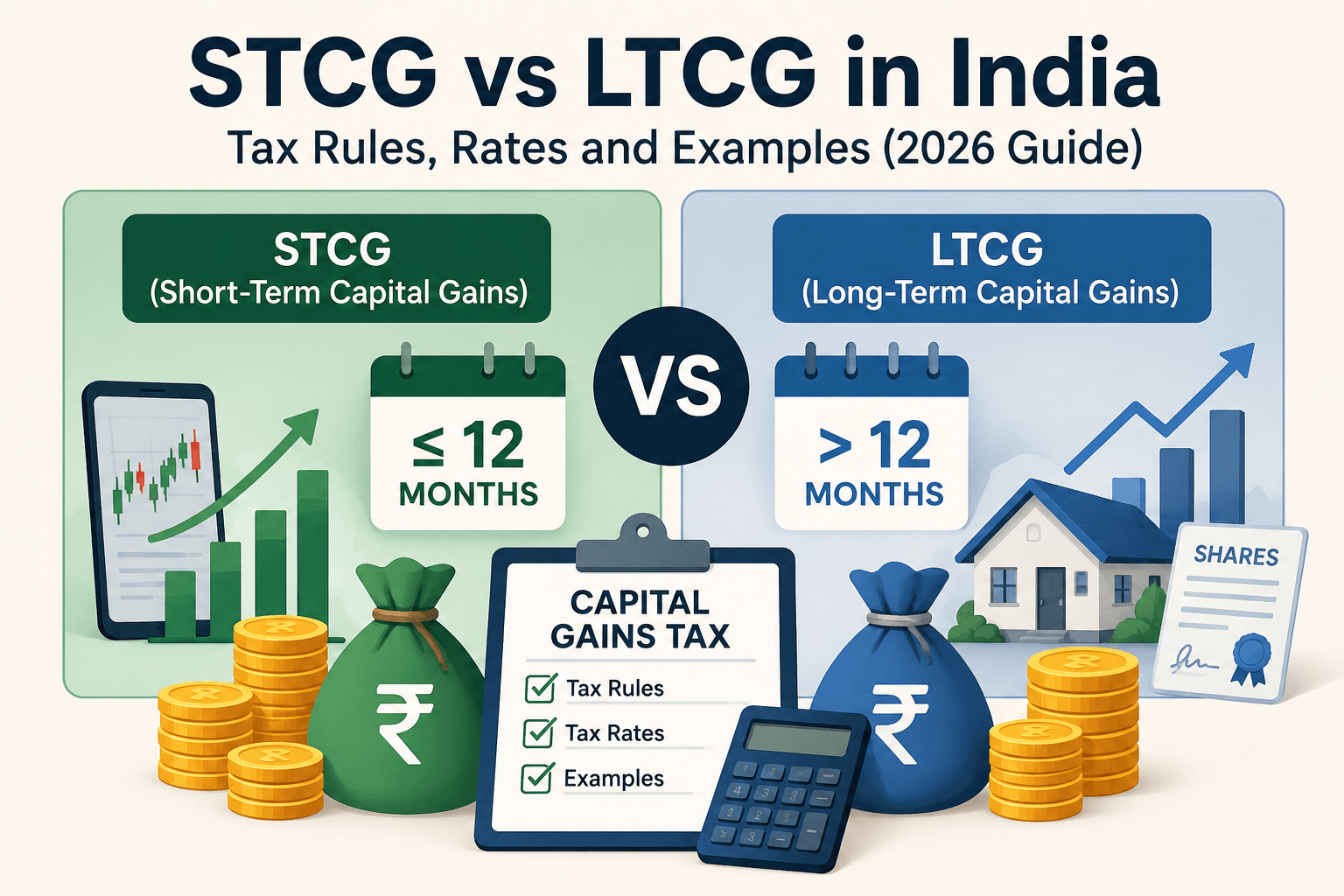
In April 2024, Rohit sold mutual fund units he had been holding for two years and made a profit of ₹2.8 lakh. He expected a small tax bill. What he got instead was confusion. His broker showed a capital gain of ₹2.8 lakh, but the rate that applied was different from what he remembered. The rules had changed in the July 2024 Budget, and nobody had told him in plain language what was actually different.
If you have ever sold — or are planning to sell — mutual fund units, stocks, gold, or property, you need to understand capital gains tax. Not the legal text version. The version that tells you the exact rate that applies to what you sold, when, and what you can legally do to pay less.
This is that guide. Every rate, every rule, and every exemption — verified from the Income Tax Department’s own publications and CBDT notifications — for FY 2025-26.
What this guide covers
Capital Gains Tax: What It Is and Who Pays It
When you buy something — a stock, a mutual fund unit, a flat, gold jewellery — and later sell it for more than what you paid, that profit is a capital gain. The government taxes that gain under the head ‘Capital Gains’, which is one of the five heads of income under the Income-tax Act, 1961 (Section 45).
Capital gains tax applies to all taxpayers — salaried, self-employed, business owners, senior citizens, NRIs. If you transferred a capital asset and made a profit, it is taxable in the year of transfer, regardless of whether you received the money in one go or in instalments.
Two things decide how much you pay: what you sold, and how long you held it before selling. Get both right and you know your tax. Most people only know one.
What Counts as a Capital Asset
A capital asset is any property held by a person — whether or not it is connected with their business. According to Section 2(14) of the Income-tax Act, the definition is wide. It includes:
- Movable property: shares, debentures, mutual fund units, bonds, gold, gold ETFs, gold sovereign bonds, jewellery, paintings, sculptures
- Immovable property: residential house, commercial property, land, agricultural land (in certain cases)
- Intangible assets: trademarks, patents, brand names, tenancy rights
Certain assets are specifically excluded from the definition of capital asset and do not attract capital gains tax:
- Stock-in-trade (goods held for business purposes)
- Personal movable effects — clothing, furniture for personal use (but not jewellery, which is expressly included)
- Agricultural land in rural areas (as defined by the government — urban agricultural land is taxable)
- 6.5% Gold Bonds (1977), 7% Gold Bonds (1980), National Defence Gold Bonds (1980)
- Special Bearer Bonds (1991)
One point that trips people up: jewellery is not a personal effect for tax purposes. Gold chains, rings, bangles, precious stones — all of these are capital assets. When you sell inherited jewellery, the gain is taxable.
Short-Term vs Long-Term: The Holding Period Rules
The holding period is counted from the date of acquisition to the date just before the date of transfer (i.e., the date of sale is excluded). Different assets have different thresholds — this is where many people go wrong by assuming one year applies to everything.
| Asset Type | Short-Term (STCG) | Long-Term (LTCG) |
| Listed equity shares (STT paid) | Held ≤ 12 months | Held > 12 months |
| Equity-oriented mutual funds (STT paid) | Held ≤ 12 months | Held > 12 months |
| Units of business trusts (REITs / InvITs) | Held ≤ 12 months | Held > 12 months |
| Unlisted equity shares | Held ≤ 24 months | Held > 24 months |
| Residential / commercial property | Held ≤ 24 months | Held > 24 months |
| Gold, gold ETFs, jewellery | Held ≤ 24 months | Held > 24 months |
| Sovereign Gold Bonds (RBI) — at maturity | N/A | Tax-free at maturity for resident individuals |
| Debt mutual funds (bought after April 1, 2023) | Always short-term — no LTCG benefit at all | Always short-term — no LTCG benefit at all |
| Market-linked debentures (MLDs) | Always short-term (Section 50AA) | Always short-term (Section 50AA) |
| Unlisted bonds and debentures (sold after July 23, 2024) | Always short-term (Section 50AA) | Always short-term (Section 50AA) |
| Zero coupon bonds (listed) | Held ≤ 12 months | Held > 12 months |
Critical note on debt mutual funds: The Finance Act 2023 removed the LTCG benefit on debt mutual funds bought on or after April 1, 2023. Regardless of how many years you hold them, gains are taxed at your income slab rate. This was not reversed in Budget 2024, 2025, or 2026.
SIP investors — the FIFO rule: When you redeem units from a mutual fund where you have invested via SIP, the oldest units are considered sold first (First In, First Out). Each SIP instalment has its own date of purchase. This means some units may qualify as LTCG and others as STCG in the same redemption. Your capital gains statement from the AMC will break this down.
STCG and LTCG Tax Rates for FY 2025-26 — The Complete Table
The Finance (No. 2) Act, 2024 (Budget 2024, July 23, 2024) made the most significant overhaul to capital gains taxation in years. Budget 2025 and Budget 2026 made no changes to these rates. The following rates are current for the full FY 2025-26.
| Asset | STCG Rate | LTCG Rate | LTCG Exemption |
| Listed equity shares — STT paid (Sec 111A / 112A) | 20% | 12.5% | ₹1.25 lakh per FY |
| Equity-oriented mutual funds — STT paid | 20% | 12.5% | ₹1.25 lakh per FY |
| Units of business trusts (REITs / InvITs) | 20% | 12.5% | ₹1.25 lakh per FY |
| Property sold on or after July 23, 2024 | Slab rate | 12.5% without indexation | None |
| Property bought before July 23, 2024 and sold later | Slab rate | Choose lower: 12.5% without indexation OR 20% with indexation | None |
| Debt mutual funds (bought after April 1, 2023) | Slab rate | No LTCG — always slab rate | None |
| Gold, gold ETFs, jewellery | Slab rate | 12.5% | None |
| Unlisted shares | Slab rate | 12.5% | None |
| Sovereign Gold Bonds at maturity (resident individuals) | N/A | Tax-free | Full gains exempt |
| Market-linked debentures (Section 50AA) | Slab rate | No LTCG — always slab rate | None |
| Unlisted bonds / debentures (sold after July 23, 2024) | Slab rate | No LTCG — always slab rate | None |
Cess and surcharge: All rates above attract an additional 4% health and education cess. Surcharge applies if your income exceeds ₹50 lakh. For most salaried Indians in the ₹10–30 lakh range, the effective rate on equity LTCG is approximately 13% (12.5% + 4% cess).
Section 87A rebate does not apply to special-rate capital gains: Even if your total income is below ₹12 lakh under the new tax regime, the ₹60,000 rebate under Section 87A cannot be applied against STCG at 20% or LTCG at 12.5%. These are taxed at their special flat rates regardless. This catches many salaried investors off guard at the time of ITR filing.
The July 23, 2024 Pivot: What Changed and What It Means for You
July 23, 2024 is the single most important date in recent capital gains history. Three things changed from that date:
1. STCG on equity jumped from 15% to 20%
Short-term capital gains on listed equity shares and equity mutual funds were taxed at 15% until July 22, 2024. From July 23, 2024, that rate became 20%. If you sold equity shares before that date in FY 2024-25, the 15% rate still applies to those transactions.
2. LTCG on equity went from 10% to 12.5%, exemption raised to ₹1.25 lakh
Long-term capital gains on listed equity and equity mutual funds were taxed at 10% (above ₹1 lakh exemption). Post July 23, 2024, the rate is 12.5% but the annual exemption was also raised from ₹1 lakh to ₹1.25 lakh — a partial offset. For FY 2025-26, the full year applies at 12.5% with the ₹1.25 lakh threshold.
3. LTCG on property and other assets: uniform 12.5% without indexation
Before July 23, 2024, LTCG on property, gold, and most other non-equity assets was taxed at 20% with the benefit of indexation. From that date, the rate dropped to 12.5% but indexation was removed. A flat rate, no inflation adjustment.
However, the government gave a one-time relief for assets acquired before July 23, 2024: the taxpayer can choose whichever calculation gives a lower tax — 12.5% without indexation, or 20% with indexation. This option applies only to land and buildings, not to gold or shares.
Indexation, CII 376, and the Calculation Choice for Property Sellers
Indexation adjusts your purchase price upward for inflation, using the Cost Inflation Index (CII) published annually by CBDT. By inflating your cost of acquisition, it reduces your taxable gain — and that used to be a significant tax saver on long-held property.
For FY 2025-26, CBDT has notified the CII as 376 via Notification No. 70/2025, dated July 1, 2025. The CII for FY 2024-25 was 363. The base year is 2001-02, with CII = 100.
Indexed cost formula: Indexed cost of acquisition = (Original purchase price × CII of year of sale) ÷ CII of year of purchase
Here is a real example to show why the choice matters. Say Priya bought a flat in FY 2015-16 for ₹50 lakh (CII that year: 254) and sold it in FY 2025-26 for ₹90 lakh (CII: 376).
| Method | Calculation | Tax Payable |
| 12.5% without indexation (new rule) | LTCG = ₹90L − ₹50L = ₹40L → Tax @ 12.5% | ₹5.00 lakh |
| 20% with indexation (old rule, if bought before July 23, 2024) | Indexed cost = ₹50L × 376 ÷ 254 = ₹73.9L → LTCG = ₹16.1L → Tax @ 20% | ₹3.22 lakh |
In Priya’s case, using the old indexation method saves ₹1.78 lakh. She gets to choose. For properties bought only 2–3 years ago, 12.5% without indexation is often the better option. For decade-old assets, indexation usually wins. Always calculate both before deciding — or have your CA do it.
For property acquired on or after July 23, 2024, there is no choice. It is 12.5% without indexation, period. And indexation is no longer available for gold, shares, or debt mutual funds under any circumstance.
How Capital Gains Are Calculated — Real Rupee Examples
Example 1: Salaried investor with equity mutual fund SIP redemptions
Vikram has been doing a SIP in an index fund since 2021. In FY 2025-26, he redeems some units. His AMC’s capital gains statement shows:
- LTCG: ₹2,20,000 (units held more than 12 months)
- STCG: ₹40,000 (some units bought within the last 12 months, sold before completing one year)
Tax calculation:
- LTCG exemption: First ₹1,25,000 is completely tax-free
- Taxable LTCG: ₹2,20,000 − ₹1,25,000 = ₹95,000
- LTCG tax: ₹95,000 × 12.5% = ₹11,875
- STCG tax: ₹40,000 × 20% = ₹8,000
- Total tax (before 4% cess): ₹19,875
- After 4% cess: ₹20,670
Vikram’s Form 16 from his employer will not mention any of this. He has to declare these gains himself under Schedule CG when filing his ITR.
Example 2: Selling property with the indexation choice
Meera bought a house in FY 2010-11 for ₹35 lakh (CII that year: 167). She sold it in FY 2025-26 for ₹1.10 crore (CII: 376).
| Method | Calculation | Tax |
| 12.5% without indexation | LTCG = ₹1.10Cr − ₹35L = ₹75L → @ 12.5% | ₹9.375 lakh |
| 20% with indexation | Indexed cost = ₹35L × 376 ÷ 167 = ₹78.8L → LTCG = ₹31.2L → @ 20% | ₹6.24 lakh |
Meera saves ₹3.13 lakh by going with the indexation method. Since the property was bought well before July 23, 2024, she can legally choose the lower-tax route.
Example 3: STCG on direct equity shares
Arjun bought 500 shares of a listed company in September 2025 at ₹400 each (₹2 lakh total). He sold them in February 2026 at ₹520 each (₹2.6 lakh total). Holding period: 5 months — short-term.
- STCG = ₹2,60,000 − ₹2,00,000 = ₹60,000
- STCG tax = ₹60,000 × 20% = ₹12,000
- After 4% cess = ₹12,480
STT (Securities Transaction Tax) would have been deducted at the time of sale through his broker, but STT is separate from STCG tax — it does not substitute for it. Both apply.
Legal Exemptions That Can Reduce or Eliminate Capital Gains Tax
The Income-tax Act provides reinvestment-based exemptions that allow reducing or deferring capital gains tax. These are available only on LTCG, and each has strict conditions. The three most relevant for salaried Indians are Sections 54, 54EC, and 54F.
| Section | Who Can Claim | What Was Sold | What You Must Reinvest In | Deadline | Key Limit |
| Section 54 | Individuals and HUFs only | Residential house property (long-term) | Another residential house property in India | Buy within 2 years OR construct within 3 years from date of sale | Max exemption ₹10 crore; up to 2 properties if LTCG ≤ ₹2 crore (once in lifetime) |
| Section 54EC | All assessees | Land or building or both (long-term) | Specified bonds: NHAI, REC, IRFC, PFC, HUDCO (CBDT Notification No. 31/2025, April 7, 2025) | Within 6 months from date of sale | Max ₹50 lakh per FY; 5-year lock-in; interest on bonds is taxable |
| Section 54F | Individuals and HUFs only | Any long-term asset OTHER than a residential house | New residential house property in India | Buy within 2 years OR construct within 3 years from date of sale | Max exemption ₹10 crore; full sale proceeds must be invested for full exemption (proportionate if partial); must not own more than 1 other house at time of sale |
Capital Gains Account Scheme (CGAS): If you cannot reinvest the capital gains before your ITR filing due date (typically July 31), you can park the amount in a designated account at a PSU bank under the Capital Gains Account Scheme. This preserves your right to the exemption. The funds must then be used for the specified reinvestment within the prescribed time limits.
IREDA bonds now eligible under Section 54EC: In addition to NHAI, REC, IRFC, and PFC, CBDT notified bonds issued by Indian Renewable Energy Development Agency (IREDA) as long-term specified assets under Section 54EC, effective July 9, 2025. HUDCO bonds were similarly notified earlier in April 2025 (Notification No. 31/2025). If you are selling property, you now have more bond options to invest in.
Exemption clawback: If you sell the new property within 3 years of buying or completing construction, the exemption claimed is reversed. The previously exempt gain gets added back and taxed in the year of that sale.
The ₹1.25 Lakh LTCG Strategy Every Mutual Fund Investor Should Use
The first ₹1.25 lakh of LTCG on equity shares and equity mutual funds is tax-free every financial year. Not reduced. Not partially exempt. Zero tax. And it resets every April 1.
If you never consciously use this, your gains just accumulate — and when you eventually sell, the taxable portion above ₹1.25 lakh gets taxed at 12.5%. That is avoidable.
Strategy 1: Tax gain harvesting
If you have unrealised LTCG in your equity mutual funds, sell enough units to realise up to ₹1.25 lakh in gains before March 31 each year. Pay zero tax. Reinvest immediately — same fund is fine, there is no wash sale rule in India. Your new cost basis is higher, which reduces future taxable gains. Repeat every year.
Example: Ananya has been doing SIPs for four years. By February 2026, her unrealised LTCG is ₹4.5 lakh. She redeems units worth ₹1.25 lakh in gains — zero tax. She reinvests the proceeds in the same fund on April 1. Over the following years, she repeats this. Each cycle, she is resetting her cost price upward legally.
Strategy 2: Tax loss harvesting
If some of your investments are sitting at a loss, sell them to realise the loss. That realised loss can be set off against capital gains in the same year, reducing your tax. The rules:
- Short-term capital loss (STCL) can be set off against both STCG and LTCG
- Long-term capital loss (LTCL) can only be set off against LTCG — not against STCG
- Unused losses can be carried forward for up to 8 assessment years — but only if you file your ITR on time by July 31
- India has no wash sale rule — you can sell and immediately buy back the same fund or stock
Caution: Sell before T+1 settlement deadlines. For equity, settlement is T+1. A transaction must be settled before March 31 to count in FY 2025-26 — so complete redemptions or sales by March 28 or 29 at the latest (check trading calendar). Mutual fund redemptions settle in 1–3 business days.
Capital Gains in Your ITR: What Goes Where
Capital gains from any source — mutual funds, stocks, property, gold — are not captured in Form 16. Form 16 only reflects salary income and TDS on salary. You must declare capital gains yourself in your ITR, under Schedule CG.
Documents you need before filing
- Capital gains statement from your broker (Zerodha, Groww, Upstox, Angel One — all have this under the tax P&L section)
- Capital gains statement from CAMS and KFintech if you have direct mutual fund investments
- Sale deed and purchase deed for property transactions
- Valuer’s certificate for inherited property or jewellery (to establish cost of acquisition)
- Form 26AS and AIS (Annual Information Statement) from the income tax portal — these auto-populate sale proceeds from your broker and registrar; reconcile them with your own figures
Which ITR form to use
- ITR-1 (Sahaj): Salaried income only, no capital gains. If you have any capital gains at all, you cannot use ITR-1.
- ITR-2: For individuals with capital gains from shares, mutual funds, or property. This is what most salaried Indians with investments will use.
- ITR-3: If you have capital gains plus business or professional income (including F&O trading, which is treated as business income).
Capital gains interact with your tax regime choice too. If you have significant capital gains, switching between the old and new tax regime may change which is more beneficial. Run the numbers both ways before filing.
Common Mistakes Salaried Investors Make on Capital Gains
- Filing ITR-1 when they have mutual fund gains. ITR-1 is not valid if you have capital gains of any kind. Filing the wrong form means a defective return notice.
- Assuming Section 87A rebate covers STCG. Even if your total income is below ₹12 lakh, the rebate does not apply to STCG at 20% or LTCG at 12.5%. These must be paid separately.
- Ignoring gains from fund switches. When you switch from one mutual fund to another within the same AMC — say, from a regular plan to a direct plan — it is treated as a redemption followed by a fresh purchase. Capital gains tax applies to the switch. Many investors overlook this.
- Missing the FIFO sequence on SIP redemptions. Each SIP instalment has its own acquisition date. When you redeem, the oldest units go first. Partial redemptions can span STCG and LTCG within the same transaction. Download the detailed capital gains statement — do not rely on an approximate figure.
- Not depositing in CGAS before ITR due date. If you sell a property and plan to claim Section 54 or 54F exemption but haven’t found a property to buy yet, park the gains in the Capital Gains Account Scheme before filing your ITR. Failing to do so means losing the exemption for that year.
- Forgetting to carry forward losses by filing late. If you have a net capital loss this year, you can carry it forward for 8 years — but only if you file your ITR by July 31, 2026. Missing the deadline means the carry-forward benefit is permanently lost.
- Not accounting for jewellery gains. Inherited or gifted gold jewellery is a capital asset. When sold, gains are taxable. The cost of acquisition for inherited jewellery is either the actual cost to the previous owner or the Fair Market Value as of April 1, 2001 — whichever is more beneficial. A registered valuer’s certificate is needed.
What to Do Right Now: Your FY 2025-26 Capital Gains Checklist
- Download your capital gains statement. Log in to your broker and your mutual fund platforms (CAMS, KFintech). Download the full capital gains report for FY 2025-26 — distinguishing STCG and LTCG separately.
- Check your unrealised LTCG on equity. If it is approaching or above ₹1.25 lakh, consider harvesting up to that amount before March 31 (for next year’s planning) to use the annual exemption. The ₹1.25 lakh you don’t harvest today becomes taxable LTCG in the future.
- Identify any unrealised losses. Look through your portfolio for investments in the red. If you have gains elsewhere, selling the loss-making positions reduces your net taxable gain. Do this before March 31 for it to count in FY 2025-26.
- If you sold property in FY 2025-26, calculate both routes. Run the 12.5% without indexation vs 20% with indexation calculation (applies only if the property was bought before July 23, 2024). Pick the one that costs less.
- If reinvesting sale proceeds, act within the deadlines. Section 54EC bonds must be purchased within 6 months of sale. For Sections 54 and 54F, you have 2 years (purchase) or 3 years (construction) from date of sale. If unsure, deposit in CGAS before July 31.
- Reconcile your AIS with your capital gains statement. The Annual Information Statement on the income tax portal shows sale proceeds reported by your broker and registrar. Check that your figures match what the department has. Discrepancies are a common reason for income tax notices.
- Pick the right ITR form. If you have any capital gains, you need ITR-2 (or ITR-3 for F&O). Filing ITR-1 is not valid.
- File by July 31, 2026. This is the deadline for salaried individuals. If you have capital losses to carry forward, missing this date permanently forfeits that benefit.
Related Reading on The Salary Investor
- SIP vs PPF: Which Is Better for Salaried Indians?
- Old vs New Tax Regime India 2025-26: Full Comparison
- How to File Your ITR Yourself: Step-by-Step Guide for Salaried Indians
- ELSS vs PPF for Tax Saving in India 2026
- Section 80C Tax Saving: The Complete Guide for Salaried Indians
Disclaimer: All tax rates, holding periods, exemption limits, and other provisions referenced in this article are based on the Finance (No. 2) Act, 2024, the Finance Act, 2025, and CBDT notifications applicable to FY 2025-26 (Assessment Year 2026-27), verified against the Income Tax Department’s official publications as of May 2026. The Cost Inflation Index of 376 for FY 2025-26 is as notified by CBDT via Notification No. 70/2025 dated July 1, 2025. Tax laws are subject to change. All examples and calculations in this article are illustrative only and are not advice for your specific situation. Outcomes depend on individual facts, dates, asset types, residential status, and the tax regime chosen. Consult a SEBI-registered investment advisor or a qualified Chartered Accountant before making investment or tax decisions. The Salary Investor is a personal finance education blog and does not provide personalised tax or investment advice.
Sources: Capital Gain — Income Tax Department, Government of India (Section 45, Classification and Tax Rates) · Exemptions from Capital Gains — Income Tax Department (Sections 54, 54EC, 54F, CBDT Notification No. 31/2025) · Tax on Short-Term Capital Gains — IT Department Tutorial (As amended by Finance Act, 2025) · Tax on Long-Term Capital Gains — IT Department Tutorial (As amended by Finance Act, 2025) · Exemption under Section 54 — IT Department Tutorial (As amended by Finance Act, 2025) · CBDT Notification No. 70/2025: Cost Inflation Index 376 for FY 2025-26 (July 1, 2025) — via Taxmann · IREDA Bonds Notified under Section 54EC (PIB Press Release, July 2025) · Budget 2024: LTCG hiked to 12.5%, STCG to 20% — Business Standard (July 23, 2024) · Capital Gains Tax Rates FY 2025-26: Full guide — Finnovate (December 2025) · Tax Loss Harvesting FY 2025-26: How to use losses to offset gains — 1Finance (March 2026)

He figured out most of what he knows about personal finance not from courses or advisors, but from years of reading, making mistakes, and fixing them. The Salary Investor is his attempt to save other salaried Indians the same time and money.
He is not a CA or a SEBI-registered advisor. He writes as a fellow salaried person who has been in the trenches — navigating EPF, ITR, 80C, salary slips, and market volatility.
- Gratuity Before 5 Years: The Legal Reality vs What HR Tells You - September 20, 2026
- ESOP Taxation in India 2026: When You’re Taxed, How Much, and What to Do at Each Stage - August 20, 2026
- How to Claim HRA Exemption If You Pay Rent to Parents — The Complete Legal Guide - August 16, 2026